Showing clients the stages of change can help them identify where they are at in their process. They might be hearing from family members or partners that they need to change something about themselves or their behavior, and they might agree. But if they are still resistant to interventions in session, it might be time to introduce clients to the stages of change.
The five stages of change were established by James Prochaska, Carlo DiClemente, and John Norcross. These counselor researchers were conducting research on treating those dealing with addictions and discovered a common set of stages that clients move between during treatment. They discovered that change is not linear (surprise!) but is a cycle that moves forward and backward through the steps.
The stages of change
1. Precontemplation
Clients often come to session in a stage of precontemplation when recommended therapy by family members and partners. Clients acknowledge that there may be an issue, but are not fully considering how they might change. They are also rarely convinced that they really should change at all.
2. Contemplation
Clients in contemplation are convinced that something needs to change. They often are severely distressed by the issues at hand and are in search of a solution. Clients have been thinking about what needs to change, but may not have a plan for change or enough motivation to take the risk to change.
3. Preparation
Clients in a state of preparation are making plans and strategies for change. Clients have accepted that something needs to change, have thought about making a change, and have decided that the risk of change is worth it. While their plan may be thorough, the final step to take action has yet to be taken. This may be the stage where clients dive into fears of change and the comfort of knowing what to expect in their current situation.
4. Action
Clients in the action stage are making moves. They are trying new strategies, making different choices, and stepping out of their comfort zone. This stage is extremely difficult and may not always feel rewarding for clients. Just because a client has taken action to change doesn’t mean they are ready to stay changed. The stress of change can bring rejection, disappointment, and sadness. Clients need support to process their emotions and remember their goals.
5. Maintenance
Clients in a stage of maintenance have done the thinking, planning, and doing of change. What matters now is building the habit and reinforcing the proof that change is actually better than how things were before. Clients in the maintenance stage may still need monthly sessions to stay motivated and hold themselves accountable.
6. (Bonus) Relapse
Some clinicians add a sixth stage, Relapse. This stage brings into awareness and normalizes the experience of committing to changing your behavior and experiencing a relapse. Including Relapse as a sixth stage can help clients expect relapse and know that a step back isn’t failure, but just another step in the process of change.
Using the stages of change in session
Clients don’t always know why they aren’t ready to change. Having a way to describe the common cycle and re-cycle of change can normalize their feelings of resistance. This visual from Evergreen Therapeutics can be a helpful tool for clients to see where they have been in the stages of change and where they are now.
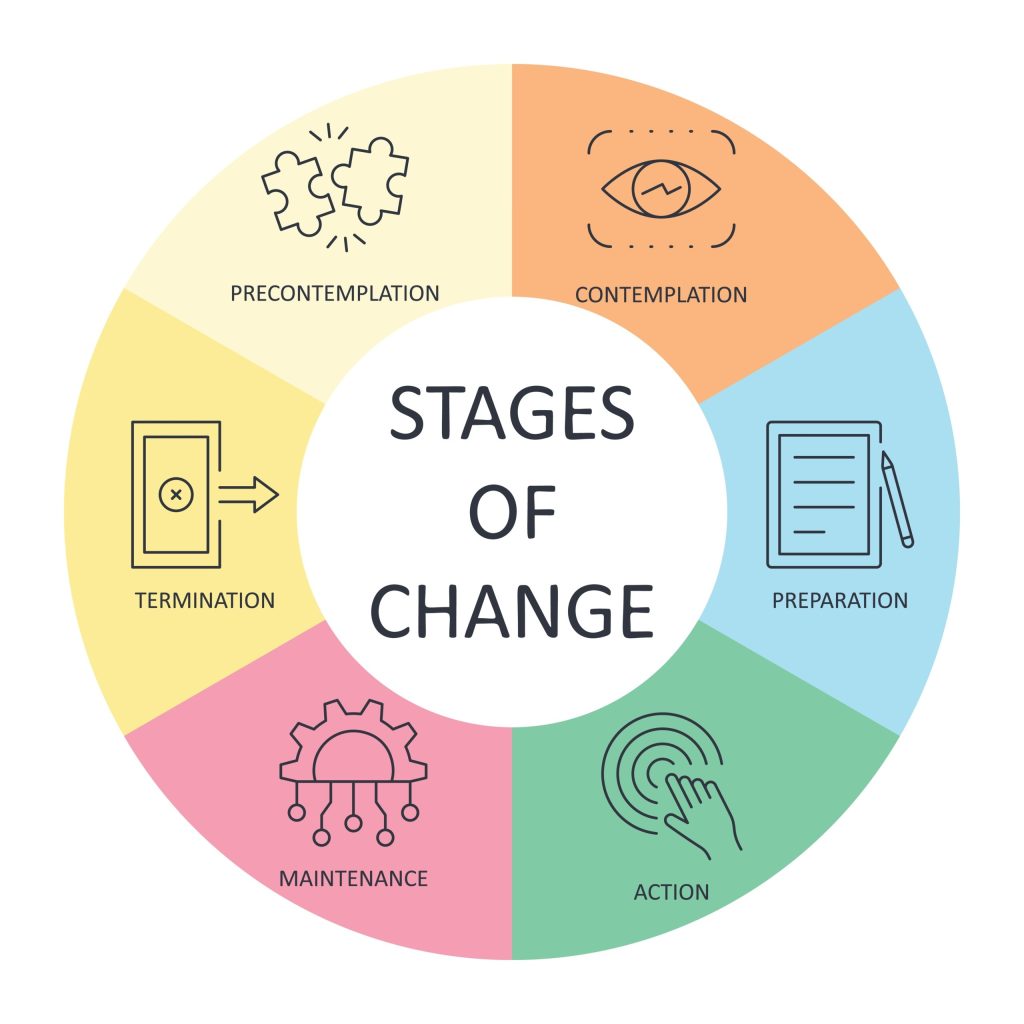
Working with clients who have been referred to counseling by loved ones can be difficult when client insight is low and they do not see any need to change. Showing clients the stages of change can put the power back in their hands. Clients can freely voice that they are not ready to take action, or maybe they aren’t even ready to think about change. Bringing that honesty into the room gives you as the counselor the opportunity to explore their resistance to change and discover what really motivates them.
Resources
Lupo, F. (2025, March 14). The stages of change: A scholarly analysis and practical application. Evergreen Therapeutics. https://evergreentherapeutics.ca/stages-of-change/
Prochaska, J. O., DiClemente, C. C., & Norcross, J. C. (1992). In search of how people change: Applications to addictive behaviors. American Psychologist, 47(9), 1102–1114. https://doi-org.lib-proxy.fullerton.edu/10.1037/0003-066X.47.9.1102




 Rookie Counseling
Leave a comment