
Having a little background knowledge on what work values often cluster together can help us with clients who are struggling to get to express their work values and goals. There are trends to note between genders (limited to the binary due to research limitations) and cultures. But people don’t always fall in line with the trends of their salient identities, sometimes a generalized working knowledge can give us a place to start with clients.
Robinson & Betz
One study by Robinson & Betz (2008) explores Super’s Work Values Inventory across ethnicities to explore cultural differences in preferred career attributes, called work values. They studied 426 undergraduate students ranging in age from 18 to 37. There was an split between male and female participants. Most participants identified as White while 9% identified as African American, 8% as Asian American, 2% as Latine, and 3% as multicultural.
The study asked various questions surrounding the Super’s work values which are achievement, coworkers, creativity, income, independence, lifestyle, mental challenge, prestige, security, supervision, variety, and work environment.
Correlated Work Values
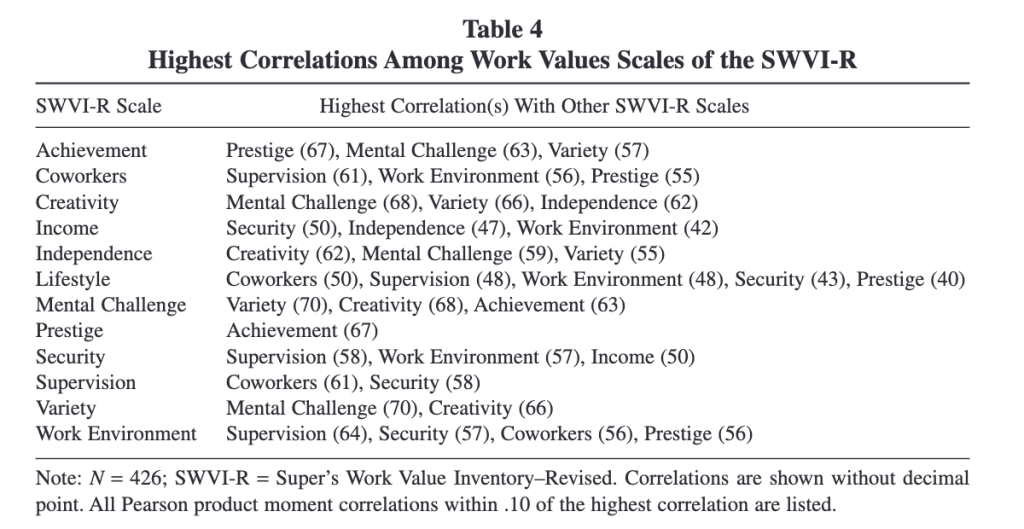
They find that work values tend to be correlated with one another. For example, they found that participants who rated income highly also typically rated security highly. Below is a table from Robinson & Betz (2008) that explores the correlations between values. By understanding how these values relate to one another, we can help clients explore their interests and help them predict which jobs will fit their needs based on their preferred career attributes. The table below indicates which attributes are correlated.
Gender Differences
Interestingly, gender differences in this study did not come into play when discussing the most and least valued career aspects. Men and women both valued creativity the least and lifestyle the most when evaluating a career. This could be because the demographic in question are students in higher education currently enrolled in Introductory Psychology. This could be excluding those who prefer to work with their hands or for themselves in a more entrepreneurial careers.
Cultural Differences
While the participants who identified as an ethnicity other than White only made up 22% of participants, there were some interesting findings surrounding cultural differences. The differences between collectivistic cultures and individualistic cultures played a big role in which work values were rated higher across cultures. Ultimately, it becomes clear in Robinson & Betz’s results that collectivism and individualism have a strong impact on which work value ratings.
Resources
Featured image from Unsplash.com
Robinson, C. H., & Betz, N. E. (2008). A Psychometric Evaluation of Super’s Work Values Inventory—Revised. Journal of Career Assessment, 16(4), 456–473. https://doi.org/10.1177/1069072708318903




 Rookie Counseling
Leave a comment