
There is a lot of information that needs to be given to a new client. You have to introduce yourself, address confidentiality and its limits, when you will be meeting, how the client wants to be addressed, and their background information. All of this is often addressed before you even approach their presenting problem.
Goals of an Initial Meeting
There are several goals involved in an initial meeting. While you are hoping to gain a lot of background information about a client’s context and the story of their presenting problem, you also want to use the initial meeting to build rapport, instill hope, and support the client. To begin with, it is always best to work toward expressing empathy, instilling hope, and building rapport.
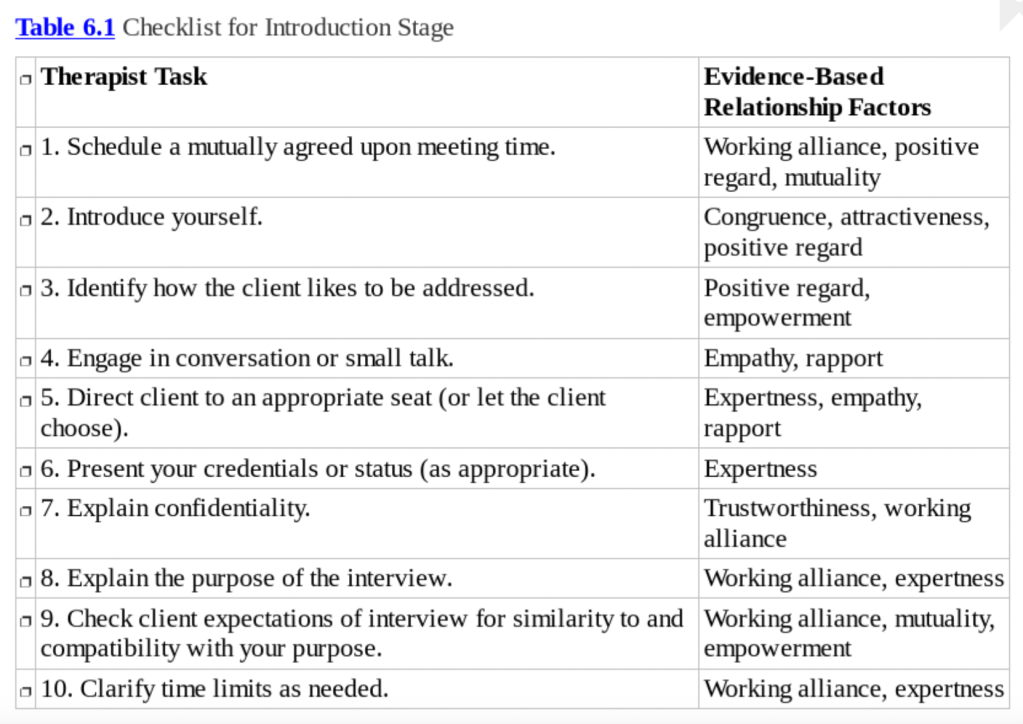
The table below is from “Clinical Interviewing” by Sommers-Flanagan & Sommers-Flanagan (2015) to help us keep our goals for the initial meeting in mind. It includes two columns, one describing therapist tasks and the other describing corresponding relationship goals of each task.
The amount of information you want to impart during the initial meeting of a client can be daunting, but there are some ways you can approach the collection of information.
Introducing Yourself
One way to ensure the client feels confident in you as a therapist and comfortable working with you is to have an opening script to introduce yourself.
Counselor introductions can include your name and pronouns, license status (trainee, associate, or licensee), client questions about intake forms, highlighting limits to confidentiality, and offering the floor to the client before jumping into any counselor questions.
One example from Integrated Behavioral Health Partners offers a conversational script for counselors which touches on many of the above topics.
This example script from Croswaite Counseling offers a less detailed, broader introduction that allows the client to tell more of their story. This approach might work better in private practice, or in a clinic that requires clients to complete the intake forms on their own.
Informed Consent
Informed consent covers a lot of important information for your clients. It is important to clearly and openly discuss the topics in informed consent because these topics are important for clients to know.
One informed consent template from Scroppo, Taube, & Zelechoski offers a good starting point for informed consent forms. It covers:
- Psychological services – what they entail, how therapy typically works, and what to expect out of the therapeutic relationship.
- Meetings – how long they will last, the typical timeline for evaluation, and scheduling and cancellation.
- Professional fees – your hourly fee, charges for going over-time in session, and other services that will require a fee (meetings with other professionals, telephone calls, etc.).
- Billing and payments – when payments are expected and payment schedule options.
- Insurance reimbursement – to what extent you will assist with insurance paperwork, the client’s responsibility for knowing their own insurance coverage, and letting clients know that most insurance companies require a diagnosis to reimburse psychotherapy treatment.
- Contacting the therapist – how to contact the therapist (phone call, text, email, etc.) and who to contact when the therapist is unable to respond right away.
- Confidentiality – legal requirements of confidentiality, written information release forms, limits to confidentiality (child/elder/dependent adult abuse, plans of suicide), and additional limits to confidentiality for minors.
Intake Forms
Intake reports can seem overwhelming and interrogatory. You are asking someone to give you as much details as possible about the most personal parts of their life. The goal of an intake form is to gain as much information about your client as possible before or during the initial interview. Often, clients can be put off during an intake interview if the questions are asked in a judgmental way. Some ways to make intake forms more approachable:
- Offering the intake form both online and in person. This can help clients who have difficulty accessing online resources as well as those who have reading or vision problems.
- Include your therapeutic approach and goals at the beginning of your form. That way the client can feel a connection to you and your style.
- Offer more options for self-reporting identities. Offering “fill in the blank” options can be more welcoming to clients who do not fall into traditional binary categories like cisgender, heterosexual, monocultural individuals.
For a more in-depth look at intake forms, check out this post.
Building Rapport
Another extremely important aspect of an intake meeting is building rapport. For many clients, the first impression they receive during an intake session will determine whether or not they ever return to therapy. If you walk into your intake session assuming this could be the one and only experience your client has with therapy, you are positioning yourself to offer the best experience possible to your client.
Ways to build rapport include brief small talk to put the client at ease, collaborating with the client on goals and expectations for therapy, as well as actively listening to your client. All of these actions show your client that you care about them, their wants, and their well-being.
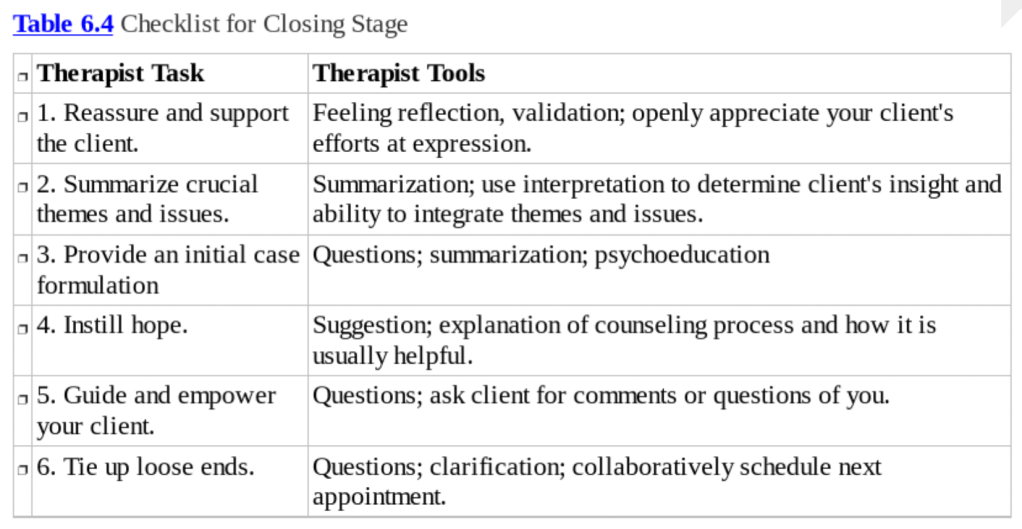
This final table from Sommers-Flanagan & Sommers-Flanagan offers overall tasks to keep in mind during the initial meeting. They offer the advice of emphasizing these tasks near the end of the meeting to leave your client feeling hopeful, empowered, and ready to take on therapy.
Addressing everything you need to cover and building rapport with a client during an initial meeting can seem daunting, but the most important task for a counselor during the initial meeting is to impart genuine empathy and care toward the client.
Resources
Carpenter, E. (2018, July 9). 6 Steps to Engage New Clients in the First Session. Croswaite Counseling PLLC. https://croswaitecounselingpllc.com/blog/2018/7/9/6-steps-to-engage-new-clients-in-the-first-session
Counselor’s Introduction To The Client Sample Script | IBHP. (2019). Ibhpartners.org. http://www.ibhpartners.org/get-started/procedures/counselors-introduction-to-the-client/
Sommers-Flanagan, J., & Sommers-Flanagan, R. (2015). Clinical interviewing. John Wiley & Sons, Incorporated.






 Rookie Counseling
Leave a comment