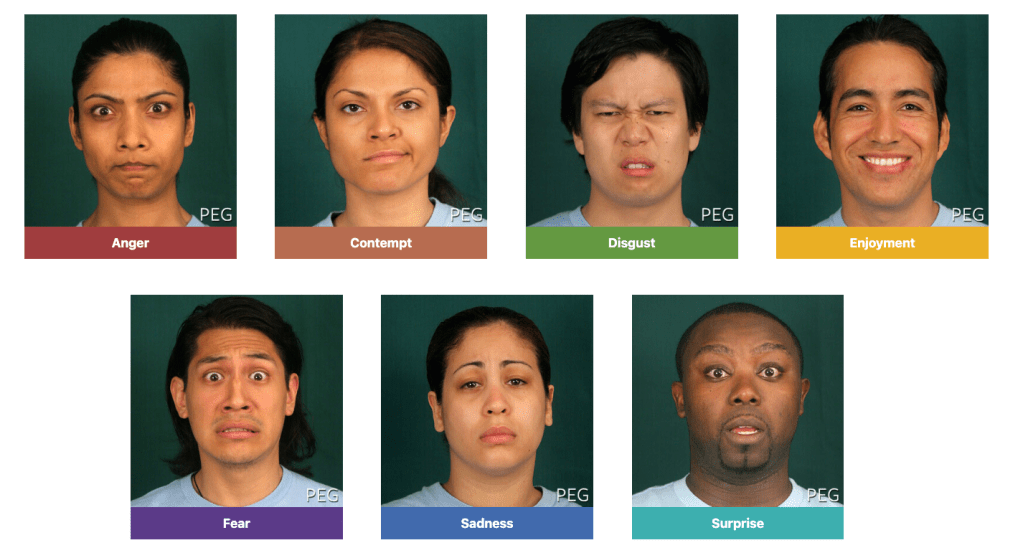
Exploring Our Core Emotions
The classic psychotherapy cliche that starts every tv therapy session is actually difficult to answer. Often, we reduce complex or confusing feelings to mad, happy, or sad. After all, these are three of the core emotions humans across cultures feel. Many agree with psychologist Paul Ekman’s theory that there are basic, innate emotions all humans share. Ekman’s study in 1972 found that across many cultures, there are facial expressions that represent universal, core emotions. Ekman theorizes that these core emotions are happiness, sadness, anger, fear, surprise, disgust and contempt. There are several useful articles that explore why we feel these emotions and how to cope with them. One such article is Healthline’s “List of Emotions” that explores six of these seven core emotions- with the exception of surprise. Popular discourse often leaves out surprise or contempt, declaring there to be five or six core human emotions.
Expanding Our Vocabulary
So, we aren’t far off the mark when we fall back on the familiar core emotions. But in difficult, new, or confusing situations, we find ourselves lacking the vocabulary to identify what emotion we are feeling. There are many resources, like Tom Drummond‘s chart below, that equip us to identify more nuanced emotions.
There is a big difference between feeling impatient and feeling vengeful. However, both are categorized as “angry” emotions. For all people, especially children, it is important to grow our emotional vocabulary. Being able to accurately express yourself is crucial for self-awareness, relationship success, and personal growth. Without understanding yourself, you cannot grow as an individual or in relation to others.
Another, brighter exhibition of feeling words is seen in the commonly used feelings wheel, developed by Dr. Gloria Willcox.
This expanded version of Willcox’s tool is useful for children and teens who don’t immediately know how they feel. Seeing a list of diverse emotions can help us find a name for what we are experiencing. In this feelings wheel, contempt is replaced with “bad” feelings that provides a category for miscellaneous unpleasant emotions.
Resources
Ekman, P. (1972). Universals and Cultural Differences in Facial Expressions of Emotions. In Cole, J. (Ed.), Nebraska Symposium on Motivation (pp. 207-282). Lincoln, NB: University of Nebraska Press.
Ekman, P. (2019). Universal Emotions | What are Emotions? | Paul Ekman Group. Paul Ekman Group. https://www.paulekman.com/universal-emotions/
Emotion Vocabulary – Tom Drummond. (2013, December 1). Tom Drummond – Resources & Writings. https://tomdrummond.com/leading-and-caring-for-children/emotion-vocabulary/
Raypole, C. (2019, September 10). List of emotions: 54 ways to say what you’re feeling. Healthline. https://www.healthline.com/health/list-of-emotions
Willcox, G. (1982). The Feeling Wheel: A Tool for Expanding Awareness of Emotions and Increasing Spontaneity and Intimacy. Transactional Analysis Journal, 12(4), 274-276. https://doi.org/10.1177/036215378201200411





 Rookie Counseling
Leave a comment