
The ability to rise above adverse life experiences is admirable, sometimes enviable. Some people seem to bounce back with ease while others crumble under the same circumstances. It turns out resilience is not solely based on someone’s personality, there are several factors that influence an individuals ability to foster resilience in the face of adversity.
Overview of Resilience (Meta-Analysis)
In the meta-analysis of resilience literature, Lee, et al. (2013) found three main factors that can be distinguished by the level of impact they have on resilience. The largest impact came from protective factors (ie. Life satisfaction, Optimism, Positive affect, Self-efficacy, Self-esteem, and Social support). The medium impact came from risk factors (ie. Anxiety, Depression, Negative affect, Perceived stress, PTSD). The smallest impact came from demographic factors (ie. Age and Gender).
An important implication of this meta-analysis is the strong influence of protective factors. In a society focused on problems, symptoms, and solutions, we often focus only on risk factors. While risk factors are important to acknowledge and validate, protective factors have a stronger influence on resilience and a greater focus on them can better help foster resilience.
Internal and External Factors
In a study on how resiliency factors can prevent youth suicide, Shahram, et al. (2021) found that two kinds of factors influence resiliency. These two factors are categorized as internal and external. Internal factors, according to a literature review, included positive self-appraisal, a “zest” for life, and coping skills.
Resilience and self-esteem are often paired together in research as indicators of an individuals well-being in the face of adverse circumstances (Bullock & Zolkoski, 2013; Fontaine, et al., 2017; Lee, et al., 2013; Quintana, et al., 2023; Shahram, et al., 2021). Because self-esteem is so closely linked to resilience, it is important to foster and maintain a health self-esteem in order to build resilience.
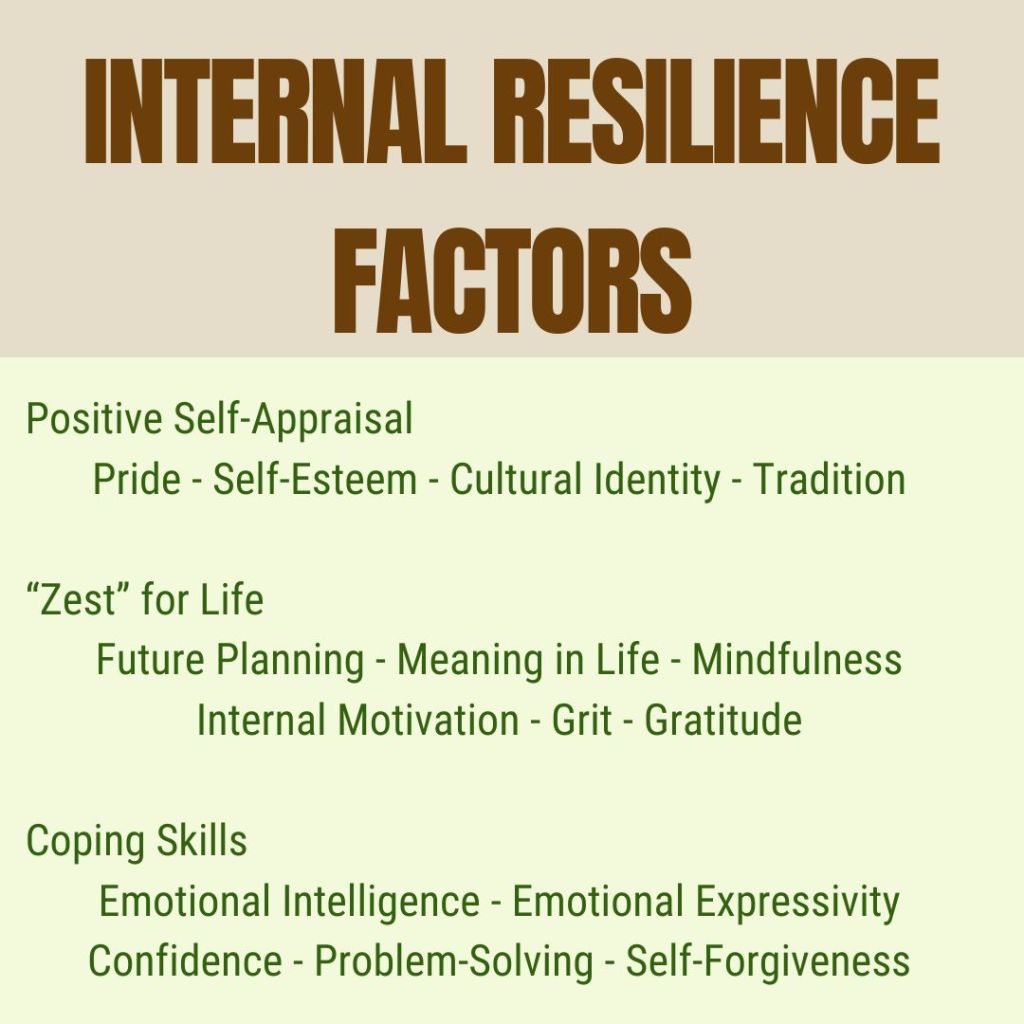
One important finding related to positive self-appraisal for indigenous youth was a participation in traditional activities (Shahram, et al., 2021). Some practical examples the authors found in their literature review are internal motivations for achievement, grit, and practicing mindfulness.
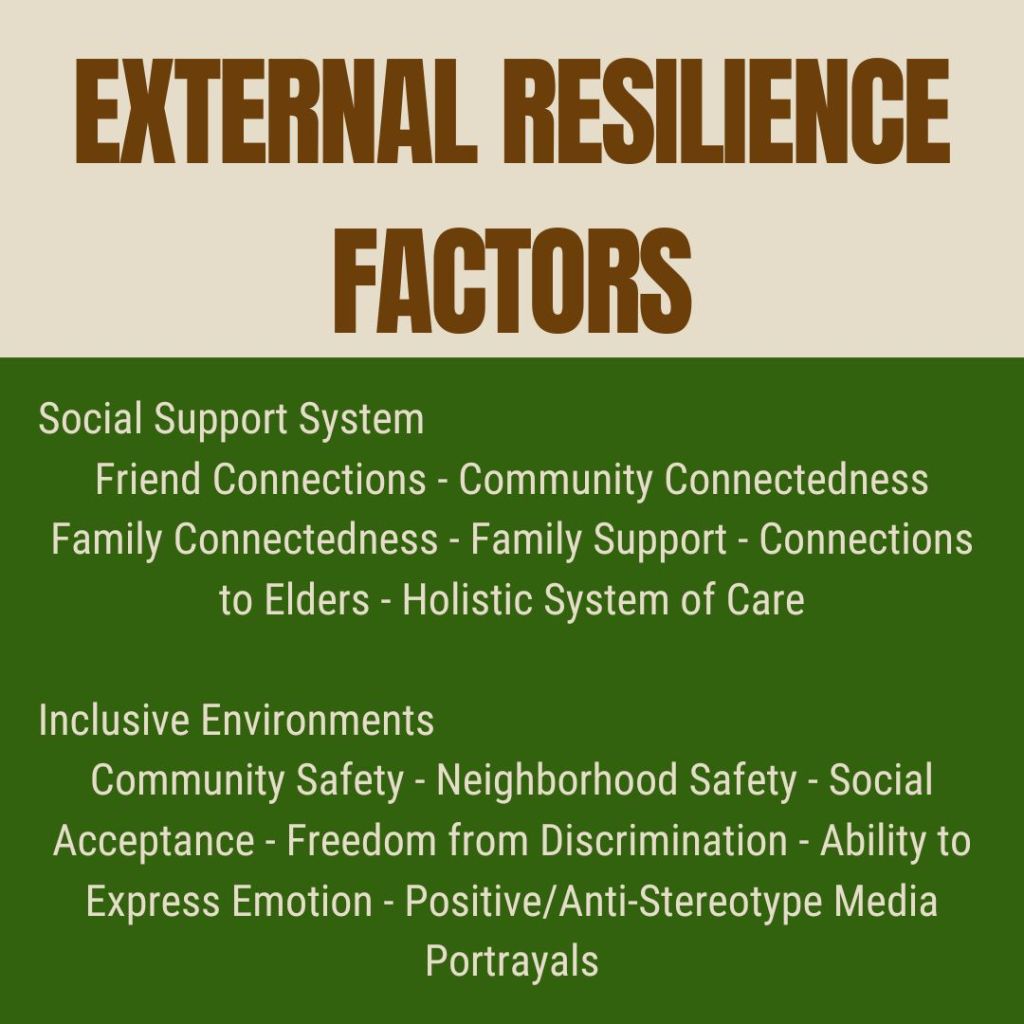
The external factors included the predictable support system and “inclusive” environments. It is easy to see how the external factors can influence a person’s resilience. What is harder to see is the internal process someone experiences as they struggle to find resiliency.
Resilience in Youth
Protective factors found to promote resilience in youth in Zolkoski & Bollock’s 2012 meta-analysis can be categorized as individual, family, and community. Individual factors in children include coping skills, autonomy, optimistic worldview, internal motivation, a positive self-concept. The most crucial of these factors, Zolkoski & Bollock argue, is self-regulation.
Family as a Protective Factor
Family support and connection, as shown in meta-analyses of literature on resiliency, is a strong protective factor for resiliency in individuals (Shahram, et al., 2021; Zolkoski & Bollock, 2013). Specifically, Benzies & Mychasiuk (2009) found that key factors that promote family resiliency are family structure, intimate partner relationship stability, family cohesion, supportive parent–child interaction, stimulating environments, social support, family of origin influence, a stable and adequate income and adequate housing.
Resiliency in the face of family dysfunction requires a unique combination of individual personality traits and external support systems. Fontaine, et al. (2017) found that positive self-esteem and emotional regulation are strongly associated with resilience in children from single-parent families attending schools in low-income areas.
Resilience in the LGBTQ+ Community
Parmenter, et al., 2021 found that key factors for resilience in individuals in the LGBTQ+ community include connection and acceptance within the LGBTQ community. This includes the experiences of sharing one’s story, feeling seen, and participating in social justice advocacy. Parmenter, et al. also note that there is often exclusion of People of Color by the wider White LGBTQ+ Community leading to discrimination, disempowerment, and exploitation (2021).
Ways to help individuals in the LGBTQ+ community foster resilience is to empower, include, and listen to individuals struggling with the many marginalized experiences within the LGBTQ+ community.
Resilience in Counseling Community
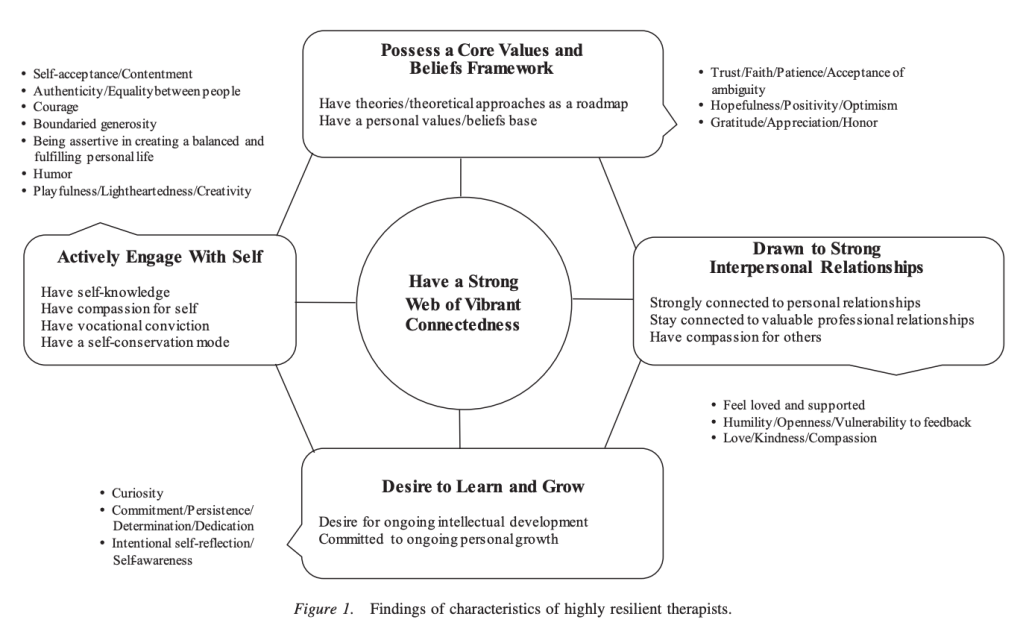
Finally, counselors often struggle with compassion fatigue, burnout, and vicarious trauma as a result of their daily work with clients. Hou & Skovholt (2020) found in their study that counselors who are highly resilient have strong interpersonal relationships, actively explore their core values and beliefs, and have a strong desire to learn and grow. A figure from their study shows the connection between these factors as well as the underlying “connectedness” that runs through each factor.
Adversity is an inevitable part of the human experience. How we see ourselves and how we connect with others can be a powerful way to build our resilience against negative life events.
Resources
Benzies, K., & Mychasiuk, R. (2009). Fostering family resiliency: a review of the key protective factors. Child & Family Social Work, 14(1), 103–114. https://doi.org/10.1111/j.1365-2206.2008.00586.x
Fontaine, C., Connor, C., Channa, S., Palmer, C., & Birchwood, M. (2017). The impact of emotional acknowledgement and self-esteem on resilience to family dysfunction. European Psychiatry, 41(S1), S734–S735. https://doi.org/10.1016/j.eurpsy.2017.01.1346
Hou, J.-M., & Skovholt, T. M. (2020). Characteristics of Highly Resilient Therapists. Journal of Counseling Psychology, 67(3), 386–400. https://doi.org/10.1037/cou0000401
Lee, J. H., Nam, S. K., Kim, A.-R., Kim, B., Lee, M. Y., & Lee, S. M. (2013). Resilience: A Meta-Analytic Approach. Journal of Counseling and Development, 91(3), 269–279. https://doi.org/10.1002/j.1556-6676.2013.00095.x
Martín Quintana, J. C., Alemán Ramos, P. F., & Morales Almeida, P. (2023). The Influence of Perceived Security in Childhood on Adult Self-Concept: The Mediating Role of Resilience and Self-Esteem. Healthcare (Basel), 11(17), 2435-. https://doi.org/10.3390/healthcare11172435
Parmenter, J. G., Galliher, R. V., Wong, E., & Perez, D. (2021). An Intersectional Approach to Understanding LGBTQ+ People of Color’s Access to LGBTQ+ Community Resilience. Journal of Counseling Psychology, 68(6), 629–641. https://doi.org/10.1037/cou0000578
Shahram, S. Z., Smith, M. L., Ben‐David, S., Feddersen, M., Kemp, T. E., & Plamondon, K. (2021). Promoting “Zest for Life”: A Systematic Literature Review of Resiliency Factors to Prevent Youth Suicide. Journal of Research on Adolescence, 31(1), 4–24. https://doi.org/10.1111/jora.12588
Zolkoski, S. M., & Bullock, L. M. (2012). Resilience in children and youth: A review. Children and Youth Services Review, 34(12), 2295–2303. https://doi.org/10.1016/j.childyouth.2012.08.009




 Rookie Counseling
Leave a comment