
Introducing Miceli and Castelfranchi
Shame and guilt are both associated with self-judgments but they do not completely overlap. They are distinct emotions with two different sources. It is popular opinion that feelings of guilt elicit pro-social behaviors like apologies whereas feelings of shame elicit self-hating behaviors like withdrawal and isolation. However, a comprehensive analysis of past literature done by psychologists Maria Miceli and Cristiano Castelfranchi discusses a new perspective on guilt and shame.
Bringing into question old distinctions between guilt and shame, they discovered a significant overlap between situations that can lead to the two emotions. However, Miceli and Castelfranchi argue that literature supports a new perspective on what situations lead to which emotions and what behaviors those emotions bring on.
Guilt vs Shame
Ultimately, it is universally agreed that guilt and shame are two distinct emotions.
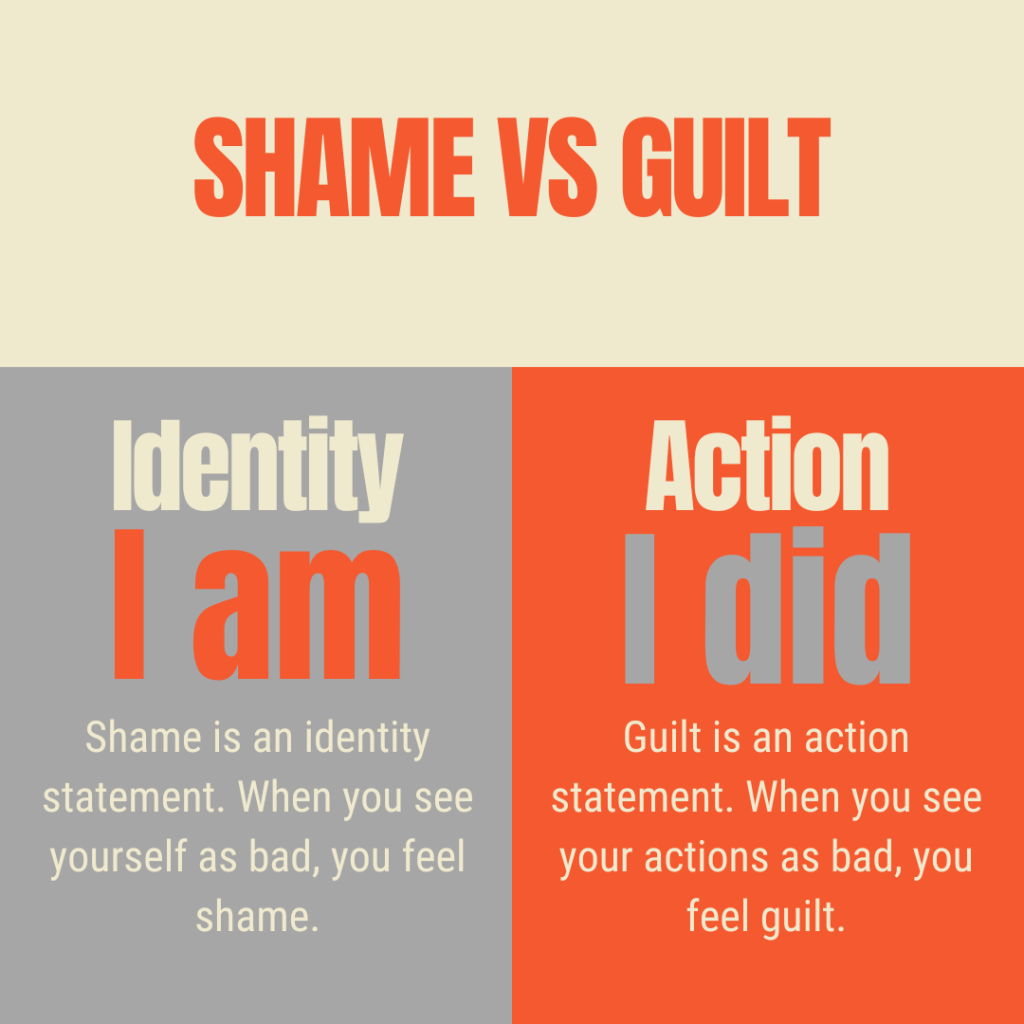
In her TedTalk entitled “Listening to Shame”, shame researcher Brené Brown shares a simple way to determine whether you are feeling guilt or shame. She classifies guilt as “I did” and shame as “I am.”
It is important to note that people can also feel responsibility for a perceived quality of self (eg. laziness) which would lead to feelings of guilt about who one is. Both guilt and shame can be elicited by the same situation.
The difference lies in the perceived responsibility for that situation.
You can also feel shame for a “bad behavior” but only if you perceive yourself as not responsible for what you believe is your personal short-coming. A sense of responsibility is the core of guilt.
A New Definition
The circumstances required to elicit guilt and shame and what behaviors those emotions lead to are often debated.
Typically, people assume guilt is an emotion brought on my a public shortcoming which inspires pro-social behaviors whereas shame is an emotion brought on by a private action which leads to self-focused emotions of withdrawal.
However, as Miceli and Castelfranchi point out, guilt can be felt without ever needing a witness. While shame over public shortcomings is also equally common. The key, according to them, is the perceived personal responsibility.
“Shame implies perceived lack of power to meet the standards of one’s ideal self, whereas guilt implies perceived power and willingness to be harmful…” which is where responsibility fits in.
Is Guilt Good and Shame Bad?
Ultimately, both emotions can lead to pro-social or “self-defensive” behaviors depending on the individual’s belief that they can change.
Guilt tends to motivate us to consider others in our assessment of personal responsibility.
Miceli and Castelfranchi write that “For feeling guilty, one must feel responsible for one’s faults; and for feeling responsible one has to consider others’ needs and concerns, and see the consequences of one’s own behavior and attitudes through their eyes.”
This typical train of thought leads people to assume that guilt leads to pro-social behavior. But guilt can also lead to self-punishment when the perceived damages seem too difficult to repair.
Additionally, we tend to classify the “ugly” emotion of shame as a self-isolation emotion. Because shame is not associated with personal responsibility but instead with identity, it does not often lead to empathic concern, but self-evaluation. However, Micali and Castelfranchi argue that shame can just as easily lead to positive behaviors such as empathy and apologies in order to restore the damaged self-image.
Where Both Go Wrong
Ultimately, when shame or guilt lead to a “global negative self-view” it leads to unproductive self-hate. When we arrive at this “global negative self-view” we can acknowledge that we are no longer in a productive headspace.
When we honestly assess our responsibility for our short-comings, we can work toward growth and repairing our self-image. Guilt and shame become unnecessary and damaging when we focus on feeling hopeless and unable to change. As psychologist Annette Kämmerer notes, “it is much easier to apologize for a transgression than it is to accept oneself.”
Kämmerer also points out findings have shown that “Women are quicker to feel humiliated than men, and adolescents feel shame more intensely than adults do.”
The pressure of social expectations and cultural norms can lead us to feel extreme guilt for mistakes and shame for our very identities. Facing the feelings of guilt and shame can seem daunting, but Micali and Castelfranchi point out an important path to growth.
How to Use Guilt and Shame
Being able to self-evaluate is crucial to taking responsibility for your actions as well as relieving yourself of unnecessary shame. When overwhelmed by feelings of shame, allowing oneself the chance to re-evaluate whether personal responsibility was involved can give the option to take action to grow as a person or accept those personal failings with compassion. After all, nobody is perfect.
When the focus is only on an irreparable self-image or the inability to live up to personal standards, the option of growth and change is thrown out.
Micali and Castelfranchi discuss the situation of a woman feeling shame for behaving cowardly in a way that falls short of her ideal expectations for herself.
“At this point, many dysfunctional consequences that have been typically attributed to shame may ensue—such as depressive symptoms, escape and/or denial, as well as a stable low self-esteem. But she can also believe that something can be done, and commit herself to become the person she aspires to be.”
Ultimately, neither guilt nor shame are completely good or bad emotions. Both can result in unproductive behaviors like withdrawal and isolation. The outcome is determined by our hope that change is possible and a determination to learn and to better.
Resources
Kämmerer, A. (2019, August 9). The scientific underpinnings and impacts of shame. Scientific American. https://www.scientificamerican.com/article/the-scientific-underpinnings-and-impacts-of-shame/
Miceli, M., & Castelfranchi, C. (2018). Reconsidering the Differences Between Shame and Guilt. Europe’s journal of psychology, 14(3), 710–733. https://doi.org/10.5964/ejop.v14i3.1564
TED. (2012, March 16). Listening to shame | Brené Brown. YouTube. https://www.youtube.com/watch?v=psN1DORYYV0





 Rookie Counseling
Leave a comment